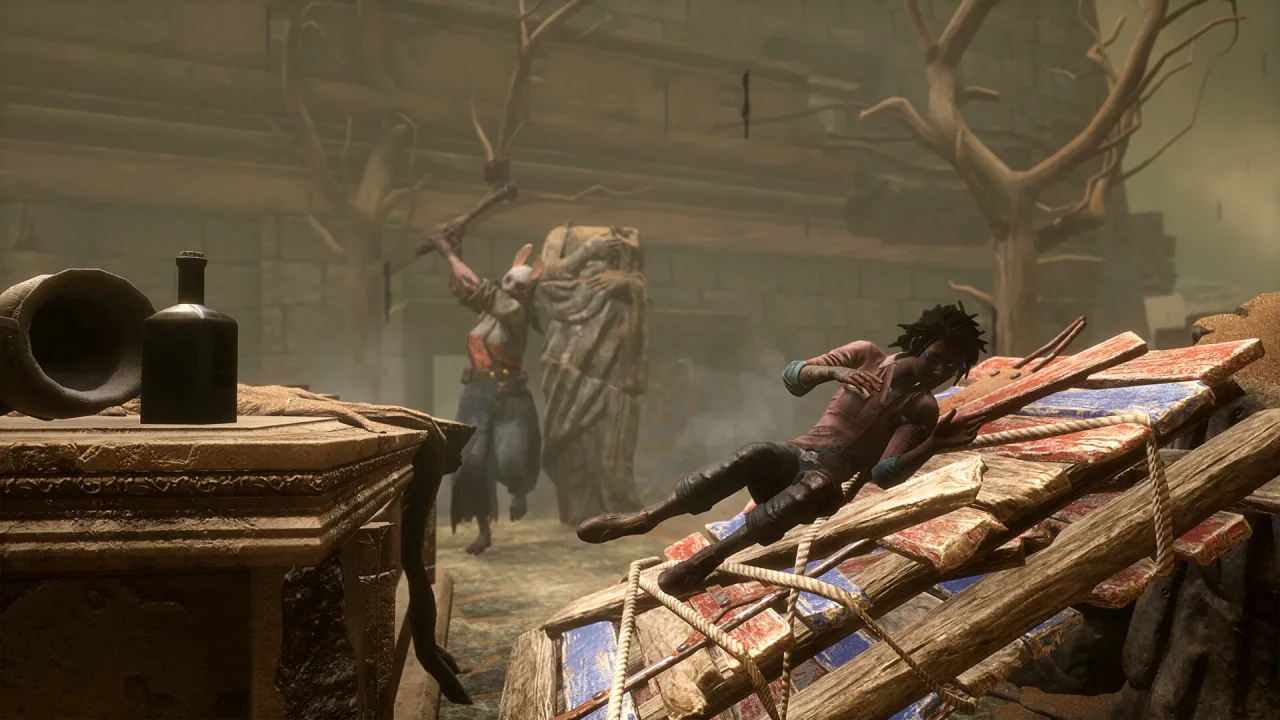
A highlighted character behind a wall is not enough to identify Dead by Daylight software. The game already has information-revealing mechanics, and a short clip may leave out the perk, viewpoint or condition responsible. That makes “ESP versus aura reading” a question about where information comes from, not simply how an outline looks.
For NoName readers, the distinction also prevents an easy purchase mistake: treating a familiar software term as a confirmed feature of the product being sold. NoName's published access information establishes licence options, key delivery and the shared loader. It does not, by itself, establish an ESP feature list.
A native example: Bond
Behaviour's official Dwight Fairfield page describes Bond as revealing nearby Survivors' auras. That is an identifiable game feature with a named source. You do not need to infer a separate software package merely because another character becomes visible.
More generally, a native information effect has rules within the game: what causes it, what it reveals and when it applies. A third-party ESP claim is a claim that separate software supplies information. Visual similarity does not make the two equivalent, just as two maps can look alike while using different data.
Separate the information from its presentation
| Question | Example of the distinction |
|---|---|
| What is identified? | A character, an object and a location are different kinds of information. |
| How is it presented? | An outline, text label and map marker are different display choices. |
| When is it available? | A temporary reveal and a continuously updated display make different promises. |
A seller saying “ESP” has not answered all three. Nor does adding more categories to a screenshot demonstrate that every label is accurate. Information volume and information quality are separate properties.
For example, a marker could identify a location accurately while leaving its elevation unclear. A busy display might also make two labels hard to distinguish. These are reasons to request a precise description; they are not benchmark findings about NoName or instructions for configuring another tool.
What a promotional clip can leave out
Imagine a ten-second sequence with several outlines visible. Before drawing a conclusion, consider the missing context: whose viewpoint is shown, whether the entire interface is visible, and whether the preceding event explains the reveal. A cropped image cannot answer questions that its framing removes.
The same caution applies in reverse. An unfamiliar overlay is not enough evidence to accuse an individual player of cheating. A comparison article should explain the categories without pretending to conduct a forensic investigation of someone else's match.
What to ask about NoName specifically
A useful question names the claimed capability: “Does the current Dead by Daylight product include this information display, and where is its supported scope documented?” That is more precise than “Does it have all features?” It also allows a clear answer if a feature is absent or not documented.
The NoName Dead by Daylight catalog currently lists 24-hour, 7-day, 31-day and lifetime access. The durations describe licences. They should not be read as separate ESP tiers, and a longer plan does not prove a broader set of displayed information.
Eligible paid purchases include the shared NoName Loader, while the delivered key stays in the purchasing account. Those are the access details readers can rely on here. A feature demonstration would need separate, current evidence tied to the actual product.
Keep permission and functionality separate
Dead by Daylight's EULA restricts unauthorised cheating utilities. A feature being technically possible does not establish that the publisher permits it. Equally, quoting that rule does not tell you which features a particular NoName release contains.
Use the native product page for the offer, a precise product question for the capability, and the publisher's documentation for game rules. Keeping those sources separate produces a clearer answer than calling every outline ESP or assuming every ESP article is a NoName specification.